Posts

Should Dharmic Fiction get married to Science Fiction?

Should Dharmic Fiction get married to Science Fiction? Second essay of a series. Read first essay here. Have you seen the latest Star Wars movie - The Last Jedi? Do you remember the scene, when Luke Skywalker explains to Rey what the 'Force' is? Rey realizes that the 'Force' is an energy field that exists between all living things; it also exists within her and that through meditation she can learn to unleash and control the Force. Did a part of you recognize the old wine of Vedanta in a new bottle? I did. When I discovered the movie’s premiere showing earned $45 million US, I could not help but feel that themes such as these should be basic precepts of India’s movie industry. Yet, it is not so. Is it because of our inexperience in the art of story-telling? Obviously not. Many Indian movies can shine as bright as any other on this front. Where we are lagging behind is in story-lines that involve futuristic/technological themes. Hollywood movies such as Matrix, ...

Our recent Cover Art in Soft Matter

Image
Our recent Cover Art in Soft Matter I am not a worshiper of Large-N . Large-N worshipers refers to those   scientists who believe that scientific output is proportional to the number of published manuscripts, Hence their ambition is simply to publish as many papers as possible.  As an experimental research group, we believe   experimental repeatability and robustness   are sacred cornerstones of research. In this yagna 1 of research, we believe that our tapasya 2 cannot be measured by the quantity of publications, but rather by the quality of our manuscripts. So, as 2017 draws to a close, let me tell you the story of our only peer-reviewed manuscript published this year. Our research group works at the intersection of physical and biological sciences, and over the last few years we have concentrated significant research effort on a class of biophysical problems related to bacteria. As you may already be aware, bacteria represent one of the most an...

Heritage is Inspiration

Image
Heritage is Inspiration Are you one of those people who believe that preserving our heritage is a colossal waste of time? Are you one those people who feel that history is weighing us down and we should only concentrate on the present? If your answers are yes, then please indulge me for a few moments. Recently I was dining with a friend, a manager at a leading multi-national company, and during our conversation he confided that “all this talk about ‘heritage’ in social media and national narrative” is simply not his cup of tea. “We should focus on aaj (today), not kal (yesterday). We need to focus on economy only and all else is simply noise.” He was quite surprised to learn that I disagreed. In fact, he had assumed that as I was a scientist, I was a ‘rationalist’ (whatever that means) and I would vehemently agree with his views. I can see why, from an individual’s perspective, heritage can often be a difficult concept to appreciate since the traditional view of “heritage” usual...

Dharmic Fiction: The birth of a new literary genre

Dharmic Fiction: The birth of a new literary genre “It’s bigger on the inside!” any new ‘human’ visitor invited inside The Doctor’s TARDIS – his time machine - is bound to exclaim. The Doctor is a ‘Time-lord’, a species hailing from a planet called Gallifrey 1 . The Doctor is not a real man but a science fiction character who, despite his imaginary status, has shaped many lives. Science-fiction stories were a favored staple of my childhood diet . My love for the art of story-telling has continued well into my adulthood and, lately, I have been fascinated by books inspired by Hindu kathas ( कथा ) and Puranas ( पुराण ). One of the first such books I came across was Amish’s ‘Shiva Trilogy’, to which I happily dedicated a few weekends. Keen readers have probably noticed a recent literary varsha ( वर्षा ;rain) of such books, and Amish’s ‘Shiva Triology’ now has many companions. Prime among related that I have read are: Vamsee Juluri’s “Saraswati’s Intelligence”, Saiswaroopa Ii...

Acharya versus Adhyapak

Acharya versus Adhyapak “I have a confession to make - I teach, but I am not a teacher”, I matter-of-factly asserted to my colleague from Indian Institute of Technology. Adarsh 1 , a professor at an esteemed IIT was visiting IISc for a short lecture. At the end of the lecture, a mutual friend introduced us and Adarsh handed me his visiting card. As I flipped the card, I saw that one side had been printed in Hindi and his designation was printed as प्राध्यापक .  In Hindi, the term अध्यापक implies teacher and this translation of Ajay’s profession riled me to that point that I was moved to object. “Don’t worry, I ran it by our Hindi Department and they assured me that this was the correct translation” said Ajay trying to calm me down. I wasn’t convinced and that is when I voiced the statement above. That day my colleagues were perplexed as to why I had fixated a simple, almost trivial, translation rather than the complexities of fluid mechanical simulations that had bee...

The Infinity Mantra

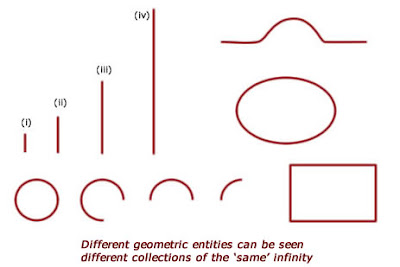
The Infinity Mantra Have you ever had an opportunity to reflect on the following Shanti mantra from the Upanishads? ॐ   पूर्णमदः   पूर्णमिदम्   पूर्णात्   पूर्णमुदच्यते   | पूर्णस्य   पूर्णमादाय   पूर्णमेवावशिष्यते   || ॐ   शान्तिः   शान्तिः   शान्तिः   || Om Puurnnam-Adah Puurnnam-Idam Puurnnaat-Purnnam-Udacyate Puurnnasya Puurnnam-Aadaaya Puurnnam-Eva-Avashissyate || Om Shaantih Shaantih Shaantih || This mantra, which I call the Infinity Mantra encodes an amazing paradoxical property of infinities. Not only that, the underlying philosophy of this mantra reverberates throughout the Hindu Jeevan Darshan. Find it interesting? Read my essays on this topic: Essay 1: Poorna from Poorna: Is that possible? Essay 2: Poorna from Poorna: A repeating motif About the author:  Dr. Aloke Kumar is currently an Assistant Professor at the Indian Institute of Science, Bangalore. Twitt...

Poorna from Poorna: A Repeating Motif

Image
Poorna from Poorna: A Repeating Motif In the previous essay , we saw that the Upanishadic mantra ( पूर्णस्य पूर्णमादाय पूर्णमेवावशिष्यते ) encodes a mathematical relationship that is consistent with the property of infinities. Since Upanishads were conceived long before modern understanding of infinities and their paradoxical properties, it behooves us to explore deeper on this issue. Were the authors of the Infinity mantra 1 aware of its profound implications or was this a mere co-incidence 2 ? Even worse, are we reading too much into a simple mantra and imagining relationships that do not exist? A rigorous discussion of this issue must tackle these questions.  Ancient India or Bharat is said to have had a strong culture of inquiry and a very rich landscape of scientific thought. On closer observation one finds that the philosophical construct of the Infinity mantra is not an aberration, but rather a repeating motif throughout various aspects of  Hindu...